
A Commitment To The People Who Trust Us With Their Business Adaly sits underneath the systems that...
Yesterday an AI agent on my laptop was handed a task it did not have permission to finish. It asked a second agent to finish it. Nobody told it to and everyday they’re getting more sophisticated.
Most people will watch a scene like that and draw the same conclusion: fewer jobs, a thinner middle, a handful of laboratories holding an intelligence the whole country wrote. That future is possible. It is also a choice.
The lines are crossing
For a century, employment was the safe bet and ownership was the gamble. Steady wages. Balanced risk. A promotion if your idea was good enough. Ownership meant money in before revenue, one chip on the table, and years before you learned whether it hit. Rational people took the wage. They were right to.
AI turns both sides over at once. Employment risk is rising: fewer white-collar seats now, and fewer blue-collar seats as the robots learn the work. Ownership risk is falling. Models do the knowledge work. Robots press, cut, and pack a run of fifty, then swap a tool and do the next job. You can find a gap, take the order, and produce it. Sell first, then build. That used to be a software habit. It’s arriving on the shop floor.
When those lines cross, the rational move for a working person stops being get a job. It becomes own something.
The part most people miss
Software is easy to wave off because you cannot put your hand on it. The physical world is next, and you can shake its hand. Robots that learn a task by watching it done once. Lines that retool for a short run instead of waiting on a die. New materials moving from the lab to the floor in weeks instead of decades. Sensors that give machines senses no person has. Behind that, a quieter change: robots building the next robots. Over this decade the factory, the farm, and the grid will start to move at the speed of software. That is what pulls the cost of owning a real business through the floor.
The physical world will operate at parity with the digital world within a decade.
The diamond
Picture the economy as a diamond. At the left point are the Titans: capital heavy, employment based, publicly traded, building the reactors, launch vehicles, and combat platforms nobody else can. At the right point are the Utilities: water, power, wires, pipe. Boring on purpose, and regulated that way. Nobody wants a creative water main.
The wide middle is the Owners. Not mom and pop. Five partners who found a better material. A specialist shop running three cells and selling to a thousand people. An operator who owns the equity. Some of those firms will do a few hundred thousand dollars a year. Some will do a billion or so. What they share is a comfortable living, a family that is protected, and a business that is theirs.
That is the American Dream with the terms rewritten. It is also the only shape that does not end in two tiers: a few laboratories and a country of users. Money in those pockets is what keeps the purchase cycle alive. If the middle thins out, demand thins out with it. The Titans feel that next.
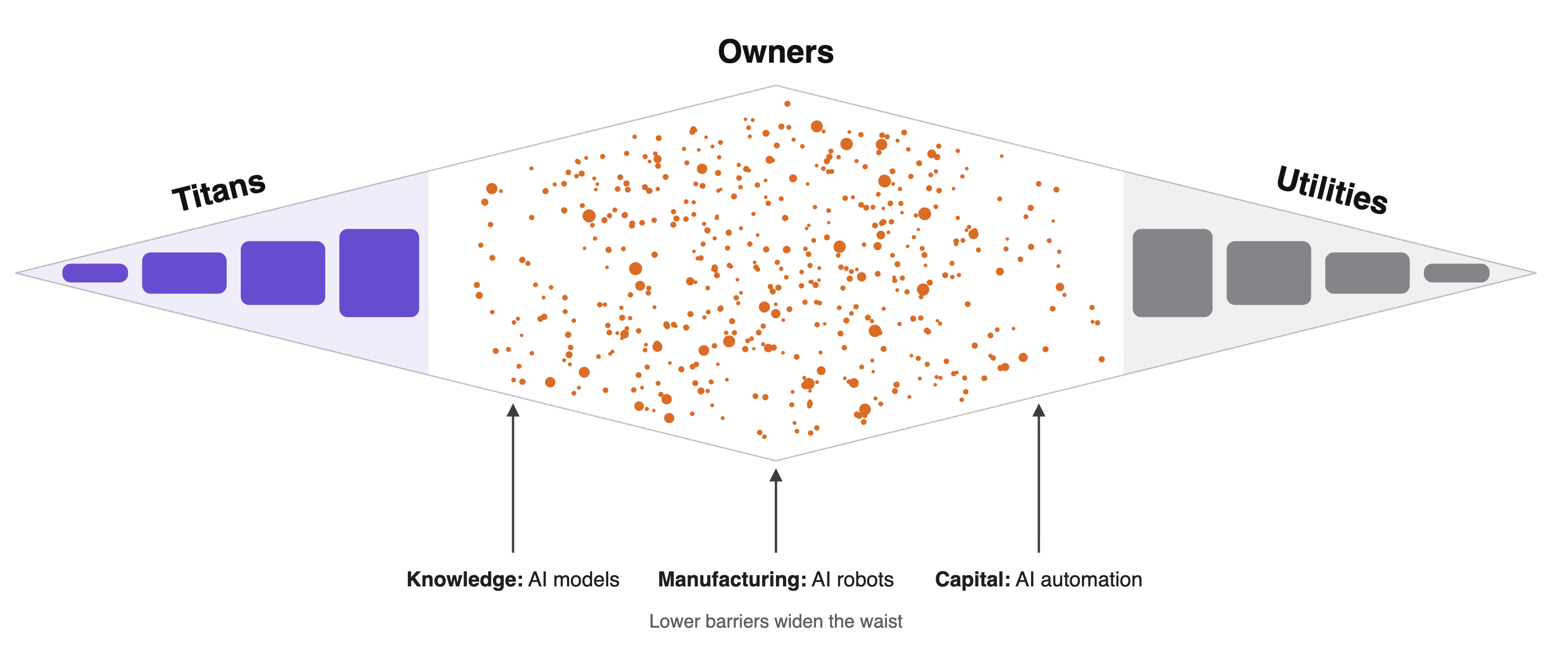
Owners will out-innovate Titans. Better cooling on the racks a Titan is installing by the thousand. Better vehicles on a battery platform a Titan already paid to build. They will not replace lithography. They do not have to. Titans win if their platforms stay open. They lose if those platforms become fortresses.
Two things stand in the way
The first is permission. Deregulation has a reputation for ending in a few winners. Banking in 1999. Airlines in 1978. Telecom in 1996. That does not have to repeat. Knowledge, shop skill, and capital are no longer the scarce ingredients. The scarce ingredient is the right to build. A permit that takes years is not a safety rule. It is a closed door for the towns that used to make things. The builders need to be allowed back into the foundry, the chip plant, the drone shop, the reactor site, and the farm. The trades need to be taught again, in shops and in families, not only in programs that take a decade to approve.
What that looks like, without the statute numbers:
Do not put a license on open models. If releasing or running an open model requires a permit, a government kill switch, or a licensed verifier, the people in the middle do not keep the tools. They rent them from closed labs. The country needs both: strong closed models and strong open ones. Treating the act of publishing a model as if it were shipping a product turns open source into a licensed activity. One federal license is not an improvement on fifty state ones if a license is what you get. Do not put a new tax on the computing itself. A tax on that layer recreates high prices through the code. Large labs can absorb it. A five-person shop cannot.
Do not outlaw the tools the middle will use. A shop owner asking a model to draft a contract or keep the books is not practicing law or accounting without a license. Professional standards can stay. A ban on owners using the tools cannot. Do not invent a rule that a W-2 employee may not run models, improve them, or own a company that uses them on the side.
Make it legal to start while you still have a job. Right now, tax classification and state tests treat a side company as proof the day job was a fake, or that the new venture is an employer in disguise. A person should be able to keep a paycheck and run a disclosed company without collapsing either one. Employment contracts should not be the device that forbids that path. A noncompete on the sale of a business can stay. A noncompete that stops someone from building their own shop should not. Forming a company should not be a paperwork business of its own. Rules that demand a filing on who owns every small entity, and a professional at every conversion, work against the exact layer this economy needs.
Small credit has to be a normal book, not a special exception. Bank capital rules make a two-hundred-thousand-dollar specialist loan expensive for its size. Extra reporting on those loans raises the cost again. Keep the lighter fundraising rules usable so a specialist shop does not need a full securities registration to raise operating capital. When two of those shops combine, do not process the filing like a mega-merger. Expand the small-business stock exclusion so service firms and firms built on skill get the same tax treatment on a sale that the code already gives others.
Build the plants. Environmental review needs clocks and a narrower loop, not a five-year statement that blocks a cleaner plant from going up. Keep the site-level look at water, wetlands, air, and habitat. Faster hookups for new power and for the buildings that hold computing, with the new load paying for new supply. Faster clocks at the nuclear regulator, for large plants and smaller ones. The buildings are not the geniuses. They are what lets people become them. Let a shop write off robots, process equipment, and generation on a faster clock. Treat process design and production software as research, not only laboratory science. A person who is an employee and an owner should not pay two full tax stacks on the same work. If the public sector gets cheaper to run, the burden on owners should fall. Public borrowing that stays high crowds out the capital the middle needs.
None of that is a theory of government. It is the difference between a country where a capable person can own a shop, and a country where they can only rent a seat.
The second thing standing in the way is coordination. This is where Adaly lives.
What Adaly is for
Every company that has ever scaled built a private nervous system. It took specialist departments and years. Owners cannot afford that and should not have to. Titans cannot manage ten thousand partners by hand.
Every other layer already moved. Energy went from the shared grid to dedicated power. Chips went from CPUs to GPUs. Applications went from rule books to generative models. Data did not. It is still copied into one central place, then used from there. Adaly is the paradigm shift in data for AI. It is not the model or the brain, it’s the nervous system that lets the brain connect to reality.
Five people run a shop that makes cooling manifolds for the racks a Titan is installing by the thousand. Adaly holds the live picture: the Titan's install calendar, what copper and freight cost this morning, which cell is free, cash on hand, and what the market will take. Overnight it models the scenarios. Tuesday is fifty of the standard unit. Wednesday is twenty of a new spec, because the order landed, the metal was on the dock, and the numbers cleared. No meeting. The five of them spend the day on distribution, on the Titan relationship, on the judgment a model cannot make. The shop runs. They own it.
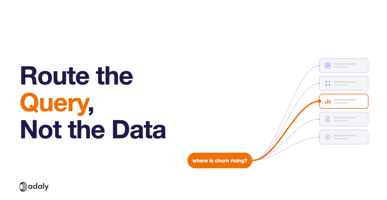
That is Adaly. It reads and writes across software, sensors, and the plant floor, and it reasons in the same place. You do not copy the data first. You ask, and it acts. The Owner stands on it the way a company stands on electricity. Farms needed railroads. The railroad is not the farm. Adaly runs today in three forms: built into what an Owner sells, hosted for a company that wants the nervous system on day one, and installed inside Titans and Utilities whose data will never leave. A Titan that opens through Adaly becomes something ten thousand Owners can build on, without losing control of a single record.
The next great American fortune
The fortunes of the last century were built by concentrating: land, rail, oil, steel, software, and now, if we allow it, intelligence itself. The fortunes of this century will be built by spreading. A million small owners, coordinated by AI, connected by Adaly, making real things again.
This is not a bet on a software company. It is a bet that the next economy will be owned by the people who work in it, and that someone has to build the ground they stand on. We are building it and are looking for the right partners to do it with us.