

With the latest news of pending IPOs, new model releases, government intervention with frontier...
AI Stack: 4 out of 5 arrived
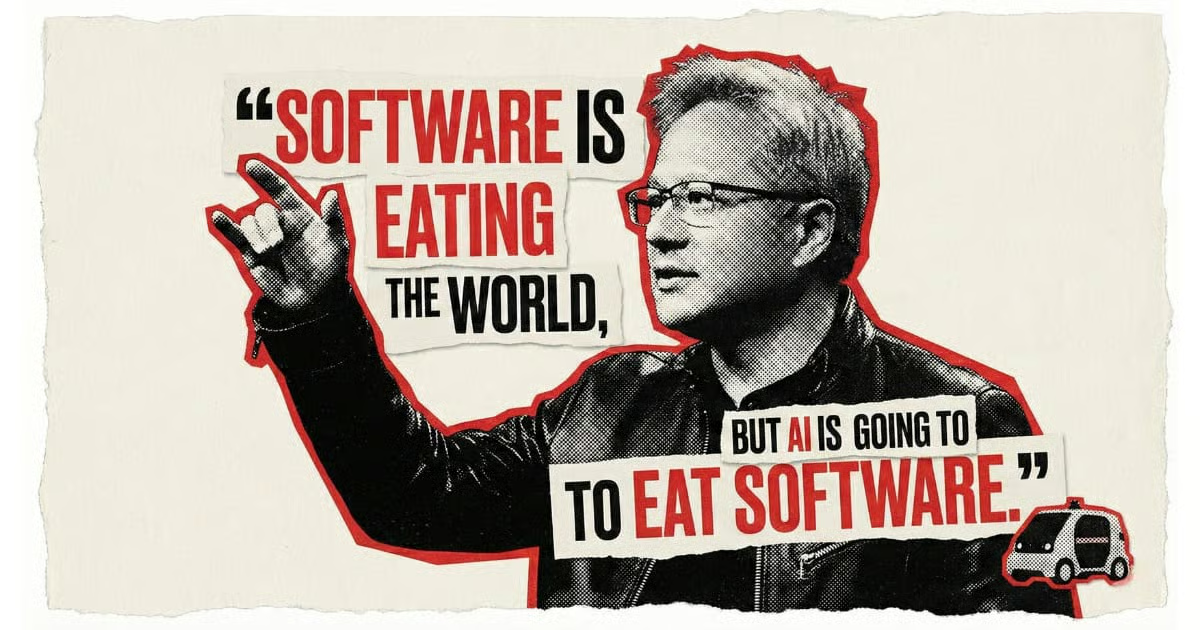
Jensen Huang has been describing AI as five layers: energy, chips, infrastructure, models, applications. He used it at Davos and again at GTC. It is a good map, and four of those five layers have clearly gone somewhere.
Infrastructure is the one worth talking about, because it has not really moved.
| Layer | From | To |
|---|---|---|
| 1. Energy | A utility bill | Companies building their own power |
| 2. Chips | CPUs | GPUs, then custom accelerators |
| 3. Infrastructure | Centralized. Warehouses, lakehouses, pipelines. | Bueller? Bueller? |
| 4. Models | Rules based | LLMs and world models |
| 5. Applications | Software a person opens | Agents that do the work |
Which infrastructure I mean
Jensen may have been talking about physical infrastructure, the racks and cooling and networking. I think the more important version is the software one, since energy and chips already cover the physical side.
The software layer is where your information lives and gets managed. Databases, warehouses, lakehouses, pipelines, catalogs. It sits above the chips and below the models, and it decides what a model is allowed to see.
Everyone agrees on where it started. It is centralized. You copy data out of the systems that create it, put the copies in the middle, and work from there.
So with everything else experiencing a paradigm shift - what's that shift for this part of the stack? Because as far as I can tell it's the same thing retrofitted.
What happened instead
Warehouse became lakehouse. Lakehouse became AI lake. Same design each time. Copy the data, transform the copy, serve the copy. When AI showed up we added vector databases and RAG, which is one more copy on top of the three already there. New names, same approach.
Copying made sense once. In 1990 compute could not reach across systems quickly, queries could not span different kinds of databases, and permissions could not travel with a request. Moving everything to one place solved all three at once, and it lasted thirty years.
Those limits are gone. The habit stayed. IDC has tracked the ratio of original data to copied data at about one to nine, so roughly ninety percent of the world's data is a copy of something else. Fivetran found teams spending 53% of their engineering time keeping pipelines running.
Why it matters more now
A stale copy used to produce a bad report and someone would catch it. An agent working from a stale copy takes an action instead, and there is nobody in between to notice.
The copy also loses the rules that came with the data. Permissions live on rows and columns in the source system, and once the data has been chunked into text for a model to read, they mostly do not come along. Researchers have found identical chunks from different customers collapsing into one record with one set of access rules. Flattening structured data into text bleaches out both of the things that made it useful, the relationships between tables and the security around them. A model can repeat your numbers without being able to do much with them.
Gartner puts the share of companies with data good enough for AI at 12%, and predicted 60% of AI projects without usable data would be abandoned through 2026. Almost none of those failures are model problems.
People have tried this
The gap is not for lack of effort. Data virtualization had the right idea twenty years ago, but the connectors were shallow and the performance was poor. Data mesh asks for a level of internal discipline most companies do not have. Zero-copy sharing works, and Salesforce has scaled it to something like 120 trillion rows a month, though only for data already inside one vendor's world. Palantir and Databricks together are a partnership rather than one architecture. MCP standardized how an agent asks a question and left the harder parts alone.
Everyone got part of the way.
What the answer looks like
If the layer started centralized, it ends up federated. Four things at once:
- Each field is defined once, in the system that owns it.
- Values are read when someone asks for them, not copied ahead of time.
- Permission is checked at the moment of access, in the source system.
- The connection reaches the whole system, not just the parts a vendor exposed publicly.
The fourth is where earlier attempts fell over. Shallow connections are fine for a demo and useless as a replacement.
What we built
Adaly is a federated data orchestration platform, and this is the part of the stack we work on. Your data stays where it is. We open a governed connection into each system, read the definition from the source, and return live values when they are asked for. Relationships and permissions stay intact, and any analysis across systems happens while the answer is being assembled.
No warehouse in the middle, no pipeline to maintain, no extra copy to secure or explain to a regulator. Our connections go all the way into each system rather than stopping at the public API, which is why Adaly can take the warehouse's place instead of sitting on top of it as another cost.
Above that sits governance and intelligence that builds itself around each customer, so the system understands how information relates across tools that have never shared a structure. Any person or any model can find what it needs and, where security allows, reach across every system required to finish the job.
That is the part of the stack nobody rebuilt, and it is what we built.